
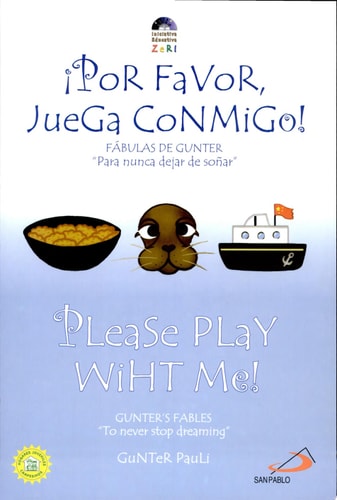
Please Play with Me! (Por Favor Juega Conmigo!)
Please Play with Me! is a beautifully illustrated, bilingual Spanish/English children's book that uses Gunter Pauli's ZERI* Education model to teach children science. In this story, a young sea lion wants to play with a sea cucumber until a passing manta ray tells him that the sea cucumber is the only one left because the rest have been harvested for food due to mistaken ideas about them. The book includes a teachers and parents guide and hands on activities that help children apply what they have learned. Gunter Pauli's ZERI* Education model proposes that children, adolescents, and young adults learn science in a way that gives them a more profound academic understanding at the same time that it helps develop their emotional intelligence, eco-literacy, and artistic/creative capacities. If children are to learn how to think, design, create, and dream in systems, then they must be exposed to systems thinking at an early age. Critical concepts become part of the child's long-term memory and the student gains an intuitive grasp of the big picture. Then the learning of the specific tools, concepts, and principles involved become far more appealing. When students start with a story that integrates ethics, economics, biology, and mathematics, they will be drawn to studying those disciplines later on. Pauli's work in sustainable manufacturing and agricultural became the catalyst for a major educational reform in Colombia. The strife and violence that exists in this country spawned an urgent desire on the part of college students to rebuild their society. The professors and engineering students at University EAFIT in Medellin, Colombia, eagerly embraced an integrated educational approach, including a compulsory course in biology for engineering majors. As the concept spread to other universities, the need to mold the earlier educational tracks in this new direction became apparent; first in a High School in Manizales where ZERI's coffee and bamboo projects have taken off, and then in elementary schools which asked for a version of this program adapted to their level, comparable to the Garden School projects of the Center for Ecoliteracy.
Sobre el autor

21 libros en la biblioteca
Gunter Pauli, destacado economista, empresario y autor, nació en Amberes, Bélgica, en marzo de 1956. Realizó sus estudios de Economía en la Universidad KU Leuven en Bélgica y obtuvo un MBA en el INSEAD, Francia. Es ampliamente reconocido como el impulsor del concepto de la "Economía Azul", un modelo de desarrollo sostenible que busca innovar y generar beneficios económicos y ambientales a partir de soluciones inspiradas en los ecosistemas naturales. Su visión propone la creación de valor y empleos a través del uso eficiente de los recursos disponibles, minimizando residuos y aprovechando lo que la naturaleza ofrece. En 1994, Pauli fundó la iniciativa Zero Emissions Research and Initiatives (ZERI), una red global dedicada a la investigación y promoción de sistemas de producción y consumo que imitan la eficiencia y circularidad de la naturaleza. A lo largo de su carrera, ha sido un prolífico autor, siendo su obra más conocida "La Economía Azul", libro que ha sido traducido a más de 30 idiomas y ha vendido millones de copias a nivel mundial. Además, ha actuado como asesor de gobiernos y empresas en distintos continentes, así como miembro de destacadas organizaciones internacionales, incluyendo el Club de Roma. Una faceta importante de su obra incluye la creación de las "Fábulas de Gunter", una colección de cuentos infantiles que buscan educar a las nuevas generaciones sobre los principios de la sostenibilidad, la conciencia ambiental y la conservación. Estas historias, basadas en hechos científicos, están diseñadas para fomentar la curiosidad, el pensamiento crítico y la participación activa de los niños en la construcción de un futuro más responsable. Las "Fábulas de Gunter" son un claro ejemplo de su compromiso con la divulgación de los valores de la Economía Azul desde la temprana edad.
Los lectores también disfrutaron


Comentarios
0 comentariosÚnete a la conversación
Inicia sesión para compartir tu opinión, responder a otros y votar comentarios.
Iniciar sesiónAún no hay comentarios sobre este libro
¡Sé el primero en compartir tu opinión!